
Self-trust is built, not found
Part 2: Behind the scenes of The Unemployment Diaries podcast

Self-trust is often treated as something you either have or you don’t. I’ve come to see it instead as a physiological state, a commitment to action, and a psychological practice — the combination of which directly shapes what we’re capable of achieving.

Picture this. It’s late morning on December 31. I’m still in my pajamas, eating half an avocado straight out of the peel. I’ve been editing the same podcast episode for two days, and for the past hour I’ve been trying (and failing) to sync the outro music with the ending transition. No life‑optimizing morning routine complete with 10-step skincare routine was followed. The new year is looming and instead of a plan for the coming months, I’m gearing up to watch the Stranger Things season finale.
Nothing about this scene looks disciplined or indicative of 2026 being my “best year ever”. But it looks like something else: trust.
You see, the second half of 2025 was exhausting. Health scares. Endless doctor’s visits. A dual‑income household suddenly reduced to unemployment wages. I was, as they say, at capacity.
So I took Dr. Dominic Ng’s advice and allowed myself to kick off the new year by doing… nothing. Nothing at all. Brain-rotting. Bed-rotting. Whatever it’s called.
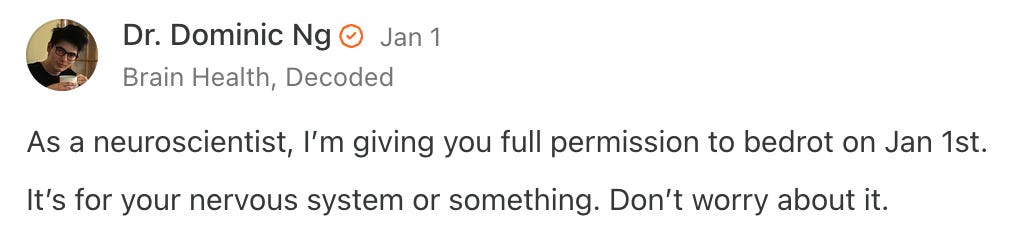
Then, on January 2, I sat down with my journal and asked myself one simple question: What was your biggest turning point last year?
Turns out, it wasn’t being laid off. It wasn’t starting this newsletter. It was the subtle, almost imperceptible moment I got so fed up with my life that I finally turned to the only person who could help.
Me.
In a self-development saturated world, turning inward seems enlightened, noble almost. But it requires something most of us don’t actually have: Self-trust.
Trust that you won’t be a jerk and berate yourself when things invariably don’t go to plan. Trust that you won’t, despite your best intentions, make everything worse. Trust that you won’t commit and then quit. Trust that you’ll figure things out.
And here’s the part we don’t talk about enough: trust isn’t just emotional. It’s physiological.
Under sustained nervous-system stress, long-term thinking collapses. Creativity narrows. The body prioritizes immediate survival over strategic planning. At that point, more pressure doesn’t motivate you. It dysregulates you. And I was applying pressure everywhere.
Figuring out what I wanted to do with my life? Pressure. Keeping the apartment perfectly tidy? Pressure. Being emotionally available to everyone but myself? Pressure.
Did I want to do those things? Absolutely. But pressure wasn’t helping me do them better. It wasn’t making me more capable.
It was just pissing me off.
So I stopped asking, What do I need to do next? and started asking a harder question: What do I need right now?
Sometimes the answer was leaving dirty dishes in the sink. Sometimes it was giving myself a little break from trying to “figure out my life.”
These aren’t acts of laziness. They’re signals of safety.
When your nervous system senses that you’re not under constant (often self-imposed) threat, capacity returns. Only then can you see clearly what actually needs your energy, and what doesn’t.
That said, self‑trust isn’t about letting yourself off the hook. It’s about taking action.
While recording for The Unemployment Diaries podcast, life coach Sofia Paredes Chaux said, “A lot of people give themselves a no before they’ve even tried walking the path.”
If I had more time, I would.
If I had more money, I would.
If I had more certainty, I would.
That was me — armed with perfectly reasonable excuses, all of them slowly diminishing how much I could trust myself. But trust isn’t built by waiting for perfect conditions. It’s built by taking steps forward with discernment, which is a whole lot easier once your nervous system is regulated.
The truth is, I didn’t need to get laid off to start writing. I was just afraid. Afraid I was wasting my time. Afraid I wouldn’t stick with it. I wanted to trust myself, but I wasn’t doing anything that required trust.
FYI: YouTube tutorials and public declarations can give you a false sense of taking action. A lot of dopamine, minimal results.
Aristotle’s virtue ethics locate character not in promises, but in repeated action. We become trustworthy by doing trustworthy things. Self-trust follows the same logic. Every follow-through builds credibility. Every miss erodes it.
Comparison was another place I was leaking trust.
We talk about comparison as the thief of joy, but that’s not its biggest crime. Comparison replaces your internal compass with someone else’s outcomes. Collecting data from other people’s lives does little more than introduce confusion and prevent me from designing a life that actually works for me.
Trust requires an internal standard. Without it, every decision feels dangerous. You’re constantly second-guessing, stalling, and outsourcing your decisions. Then you wonder why nothing you’ve “chosen” feels good enough.
In hindsight, the idea for The Unemployment Diaries podcast didn’t come from a sudden burst of clarity. It came from years of paying attention. From noticing what energized me, what drained me, and what kept asking for my attention. For a long time, I mistook that period for stagnation. Old journals dating back over 15 years are rife with frustration and self-criticism: I can’t believe I still don’t know what I want to do with my life. There are abandoned blogs, half-built ideas, lots of insight — and very little follow-through.
What I see now is the incubation of a platform that will offer a home to the stories of those who were able to trust themselves enough to take the road less traveled: the innovators, the rule-breakers, the quiet chameleons, and the brave individuals who were willing to be unemployed — unemployed by beliefs, systems, or environments that held them back.
Will I run out of money in the process? Possibly. Will I go back to corporate or find another way to support myself? Also possible. Do I know how all this will turn out? No, I don’t.
Trust doesn’t require answers in advance. It requires confidence in one’s capacity to respond.
Wonderfully written and I could identify with everything you wrote here. I’m excited for the first episode of The Unemployment Diaries. At 52 years old I’ve also come to realize that these things can only happen when the timing is right. Mindsets shift and priorities change. This exact thing happened to me in 2020, but the leap of faith that I’m taking now is much different that the actions I chose then. I didn’t believe enough in myself back then. This time I do. Similar to you, I may or may not succeed. But I think just by trying, we’ve already won. This takes a lot of courage. Best of luck as always 🩷
What I always tell everyone is, you don't need confidence or self trust to do things. You should still go and do it. The only way you will build self trust is by doing and proving your mind that despite of what it tells you, you are capable.